
Artificial intelligence (AI) is already in our classrooms, although we do not always notice it. From students asking chatbots for homework assistance to teachers trying out AI lesson planners and grading tools, the technology is seeping into our daily practice. The question for Pakistan is not whether AI will transform education; it is whether we will use it to extend quality and equity.

The Opportunity: Personalization, Productivity, and Scale
AI can provide the type of high-frequency, high-quality support that most classrooms struggle to provide. Adaptive tools can tailor practice, diagnose misconceptions in real time, and nudge learners toward mastery at their own pace. Early evidence is promising enough to be taken seriously. Research on AI tutoring has shown notable learning gains and high levels of student engagement, especially when AI is used to guide thinking rather than merely provide answers. Pilots such as Khan Academy’s Khanmigo illustrate a path where AI scaffolds students’ reasoning and frees teachers to focus on higher-order tasks like feedback and mentoring.

For teachers, AI’s upside is practical and immediate: drafting lesson plans, generating question banks, differentiating materials, and streamlining administrative paperwork. In a system where many educators juggle high class sizes and scarce resources, workload relief is not a luxury; it is what makes more personalized teaching possible.
AI also brings reach in rural or under-resourced settings where specialist teachers are rare. Well-governed AI tools could extend access to quality explanations, practice, and formative assessment at a low marginal cost. That potential can be aligned with Pakistan’s equity agenda if we combine it with investments in connectivity and devices.
The Threat: A Widening Digital Divide and Fragile Learning
Yet the risks are real. Pakistan’s digital access picture remains uneven and, depending on the source and methodology, sobering. Reports estimate 111 million internet users and a 45.7% penetration at the start of 2024, but this still leaves a majority offline. The World Bank’s most recent Individuals Using the Internet indicator reports just 27.4% for 2023, reminding us that headline numbers vary by definition, and that many households are still excluded.
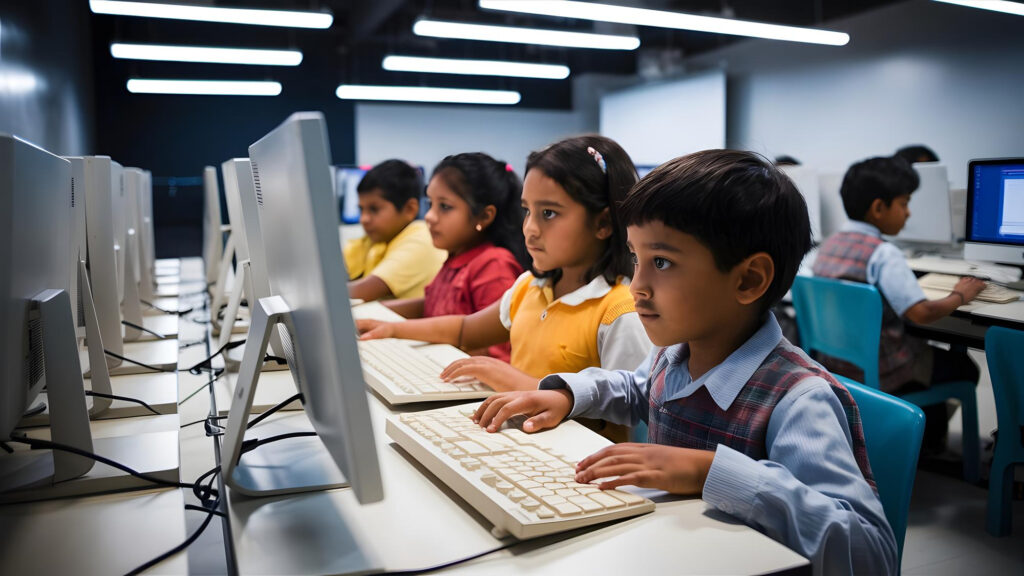
When we zoom in on schools, the challenge becomes clearer. ASER’s 2023 policy brief reports that only 12% of rural government schools have computer labs and 14% have an internet facility; even in urban government schools, the figures are 23% and 21% respectively. Household access is better, with about 61% of rural households reporting a smartphone, and 60% use WhatsApp, but that still leaves millions of children without reliable, child-friendly learning devices.
Pedagogically, there is yet another hazard: over-reliance. When AI is used as a shortcut rather than a guide, students can perform well during practice exercises but falter on transfer tasks and exams, especially in math, because the tool has displaced rather than developed core problem-solving skills. Recent studies caution that generative AI tutoring works best alongside, not instead of, skilled human teaching.
Finally, integrity risks are not trivial. Pakistan’s higher education community already treats plagiarism seriously, and universities are issuing AI-use guidelines. Without clear norms and redesign of assessments, generative tools can blur lines between assistance and authorship, eroding trust in coursework and credentials.
Where Policy Stands and Why Timing Matters
The policy window is open. In late July 2025, the Federal Cabinet endorsed the National Artificial Intelligence (AI) Policy 2025, Pakistan’s first comprehensive roadmap for responsible AI. The policy outlines a six-pillar framework and, crucially, proposes a National AI Fund by allocating a portion of the existing R&D pool managed by Ignite to catalyze adoption and skills. Education is explicitly listed as a beneficiary in objectives around public awareness, secure systems, and sectoral transformation. That is the right signal at the right time, as long as we translate it into classroom-level change.
At the institutional level, the Higher Education Commission’s plagiarism policy already anchors academic integrity, and leading universities, for example, Aga Khan University, have issued guidance on legal and ethical AI use in teaching and research. What is missing is a coherent school-sector stance: practical classroom guidelines, age-appropriate AI literacy outcomes, and alignment with curriculum and assessment reforms.
A Pragmatic Blueprint: Make AI Work for Pakistan’s Classrooms
1) Start with Equity, Not Gadgets
Before scaling fancy tools, close the basic gaps. Prioritize electricity reliability, broadband to schools, and shared device access. A sensible target, grounded in ASER’s baseline, should be to increase internet access in government schools from approximately 14–21% to at least 50% over three years, beginning with clusters where infrastructure upgrades are most feasible. Pair this with student access models (device libraries, evening community labs) that leverage the high smartphone penetration many households already report.
2) Teacher-First Integration
AI should save teachers time and improve instructional quality. Provincial PD programs can train teachers to: (a) use AI to draft differentiated materials, (b) prompt AI to generate multiple solution paths, and (c) design tasks that require student reasoning (oral explanations, written justifications, micro-vivas) so that AI cannot “do the learning” for students. Coaching should emphasize classroom management of AI and bias/error checking.
3) Assessment That Rewards Thinking
Shift high-stakes exams and internal assessments toward open-response items, portfolios, and supervised performance tasks. If questions only test recall or routine procedures, AI will outperform students, and learning will become hollow. Aligning exam blueprints with deeper outcomes is the single most powerful lever to ensure AI becomes a tutor, not a crutch.
4) Guardrails and Clarity for Integrity
Adopt simple, transparent rules: “Allowed with citation” (for idea generation, feedback on drafts), “Allowed with conditions” (for coding assistance that must be explained), and “Not allowed” (ull-solution generation for graded tasks). Institutions should require students to declare AI use and keep chat logs for audits, while avoiding blanket bans that merely drive use underground. HEC’s plagiarism framework provides a backbone; universities can append AI-specific annexes.
5) Local Content, Local Languages
Most global AI tutors are English-first. Pakistan needs Urdu and regional-language content aligned with the Single National Curriculum and provincial standards, along with contextually relevant examples. Partnerships with ed-tech companies (e.g., projects aligning with SNC) and open-source communities can accelerate content creation, supported by the new AI Fund.
6) Evidence Before Scale
Run fast, inexpensive trials in representative districts. Compare AI-supported classes with controls on common assessments; track time saved for teachers; gather student motivation and error-correction data. Publish results within an “improvement science” cycle so that policy is guided by evidence rather than hype. International findings suggest that the method of use matters as much as the tool itself. Pakistan can avoid expensive missteps by testing, learning, and adapting.
What Success Looks Like
A credible three-year vision would include:
1.Half of government schools are online with a basic device-to-student ratio for shared use.
2.Every teacher trained in prompt-craft for curriculum design and in AI-aware assessment.
3.Subject-specific, Urdu/regional-language AI tutors piloted for grades 6–10 in math, science, and English reading.
4.An exam reform package that increases the weight of constructed-response questions.
5.A published integrity code with standard AI disclosure language across universities and boards.
These are achievable steps, especially now that the national policy creates a funding and governance umbrella. The payoff is not abstract. AI, done right, could reduce remediation loads, raise foundational skills, and make classrooms more human by shifting teacher time from paperwork to feedback and relationships.
A Balanced Verdict
So, is AI a threat or an opportunity for Pakistan’s education? It is both, depending on our choices. If we treat AI as a magic wand, it will amplify inequities, shortcut learning, and corrode trust. But if we treat it as a tool, guided by teachers, bounded by ethics, and embedded in assessment and access reforms, it can widen opportunities, not the gap.
The new National AI Policy gives Pakistan a rare window to align ambition with classroom reality. Let us use it to drive three simple commitments: invest first in connectivity where the learning returns are highest; equip every teacher to be an AI-augmented professional; and redesign assessment so that students must think. Get that right, and AI will not replace teachers or students’ effort; it will elevate both.
Disclaimer: Any opinions expressed in this article do not necessarily reflect the opinions of the Pakistan Education Review. This content is meant for informational purposes only.

About the Author:
Zunaira Rehman is a published writer whose poetry, prose, and short stories have appeared in national and international websites, magazines, and newspapers. She is the author of Eternal Melodies.