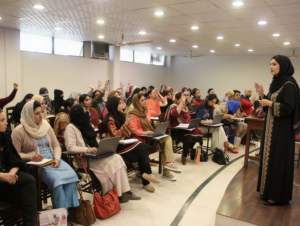


The debate over education in Pakistan has long been framed in managerial terms. Efficiency, competitiveness, and innovation. Although beneath this technocratic vocabulary lies a far deeper ideological project. The neoliberal restructuring of education into a market commodity. The notion that the failures of public institutions justify the expansion of private ones is not an organic local development but a reflection of the global neoliberal order that has shaped Pakistan’s political economy since the late Cold War.
This global realignment began in the 1980s when the International Monetary Fund (IMF) and the World Bank imposed structural adjustment programs (SAPs) across the Global South, including Pakistan. These programs demanded cuts in public spending, currency devaluation, and privatization of state assets. Education, once viewed as a social right and a means of nation-building, was redefined through the lens of market efficiency. The state was told to “rationalize expenditures,” which in practice meant defunding public schools and universities while inviting private actors to invest.

The outcome was not modernization but managed decay. Public universities that had once produced intellectuals and civil servants capable of sustaining the state’s bureaucratic machinery began to wither. Teachers’ wages stagnated, student support systems collapsed, and campuses became politically pacified zones. The narrative was then inverted. The very neoliberal elites and donor institutions that defunded education began declaring that the public sector was inefficient and corrupt. Privatization, they claimed, was the only path to progress.
This logic mirrored global trends. Across Latin America, Africa, and South Asia, neoliberal reforms turned education into a profitable frontier for capital accumulation. The World Bank’s 1995 Priorities and Strategies for Education report explicitly encouraged governments to withdraw from higher education and “create enabling environments for private investment.” In Pakistan, these ideas were eagerly adopted by local elites, not because they promised equality, but because they offered profit.
Under this regime, education ceased to function as an instrument of emancipation. Instead, it became an exportable commodity—a service industry in which universities advertise “global employability” and “competitive advantage” rather than civic virtue or intellectual depth. The student was reframed as a consumer, the teacher as a service provider, and the university as a marketplace of credentials. This transformation has carried profound geopolitical and social implications.

Domestically, privatization has deepened inequality. The children of the lower classes remain confined to crumbling public schools, while the affluent insulate their privilege through expensive private institutions that mimic Western models. Access to quality education is now determined not by talent or need, but by income. Internationally, the neoliberalization of education aligns Pakistan with a global order that privileges markets over rights, efficiency over equity, and growth over justice.
Across Pakistan, both provincial and federal governments have embraced “public-private partnerships” in education as part of broader neoliberal reforms. Often framed as reforms, donor-driven policies effectively outsource state responsibilities to the private sector. Foreign-funded NGOs and think tanks reinforce this model through development discourse, one that presents privatization as “empowerment” while ignoring its structural violence.
The geopolitical aspect cannot be ignored. Pakistan’s educational neoliberalization mirrors the broader alignment of its economic and foreign policies with Western financial institutions. By adhering to IMF conditions and World Bank frameworks, the state internalizes a foreign policy of dependency, one that subordinates social policy to global capital. The result is a dual colonization: of the economy and of the mind. The classroom becomes a place where global capitalist ideology is reproduced under the guise of “global standards.”

The crisis in Pakistan’s education sector, therefore, cannot be reduced to ethnic discrimination or administrative inefficiency. It is the manifestation of a systemic process that deliberately underfunds the public sector to justify privatization. This is not failure; it is design. The neoliberal state’s abandonment of education as a public good is not an accident of governance; it is the governing principle itself.
Reversing this trajectory requires more than nostalgia for a bygone public sector. It demands a political reassertion of education as a collective right, not a private privilege. This means increasing public funding, ensuring teacher autonomy, and re-politicizing universities as spaces of critical thought rather than corporate training grounds. It also means resisting the international financial architecture that dictates domestic policy priorities through conditional lending and aid dependency.
Ultimately, Pakistan’s educational crisis is not merely an internal dysfunction but part of a larger geopolitical structure, one that binds the country to a neoliberal order where profit eclipses people. The challenge is to reclaim education from this regime of commodification and restore it to its rightful place: as the foundation of democratic citizenship, intellectual independence, and national dignity.
Until then, every new private university built on the ruins of a public one stands as a monument to the quiet colonization of the mind, the triumph of market logic over human learning.
Disclaimer: Any opinions expressed in this article do not necessarily reflect the opinions of the Pakistan Education Review. This content is meant for informational purposes only.

About the Author:
Muhammad Raiyd Qazi is a journalist, student writer, and researcher focused on political economy, education,and social justice.