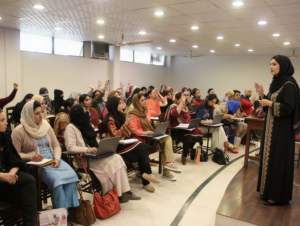

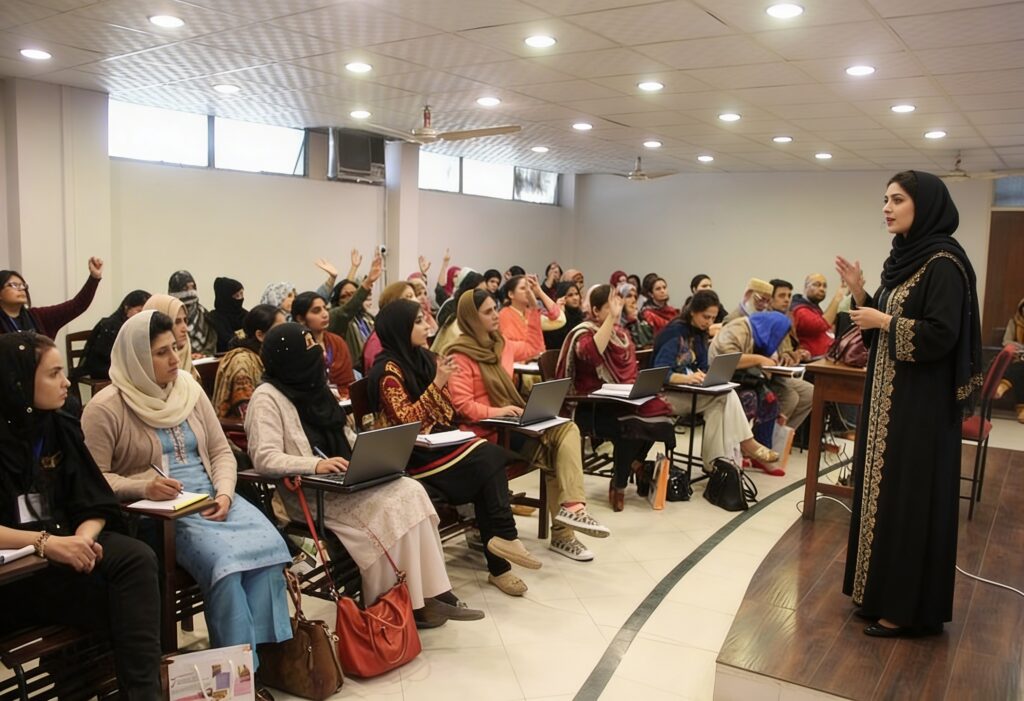
In Pakistan, teachers remain at the core of educational reform; however, the system invests far more in infrastructure, curriculum, and testing than in enhancing teacher skills and pedagogical development. World Bank analyses indicate that teacher quality is one of the strongest predictors of learning outcomes, and by 2022, nearly three-quarters of primary teachers in Pakistan were officially classified as trained. Although 79.5 percent of primary teachers were designated as “trained,” the Pakistan Learning Poverty Brief reports that 80 percent of late-primary-age children still cannot read with comprehension, and 32 percent are not enrolled at all. Each primary-age child in Pakistan receives approximately USD 397 in spending, which is roughly a third of the South Asian average. This discrepancy between “trained teachers” and “untrained learners” reveals a systemic failure: Pakistan’s current teacher certification and professional development models emphasize credentials over demonstrated competence.
Teacher training remains largely static, relying on formal degrees, lecture-based instruction, and politically influenced recruitment rather than performance-based evaluation, structured mentoring, and technology-integrated professional development. If Pakistan is serious about improving learning outcomes—not merely expanding enrollment—it must fundamentally redesign how teachers are certified, supported, and evaluated throughout their careers.
The Myth of the “Trained” Teacher
According to official data, Pakistan’s education system appears to have improved. UNESCO and World Bank statistics show that nearly four out of five primary teachers are now recognized as trained. Yet the same system continues to produce some of the highest rates of learning poverty in South Asia.

The core problem lies in what is considered “trained.” Teacher certification remains heavily focused on academic degrees. If a candidate holds a B.Ed. or M.Ed., passes a relatively basic entry test, and secures a post, often through political or social influence, they are considered fully qualified. There is almost no obligation to demonstrate actual classroom competence, even five or ten years later. There is no systematic check on whether a teacher can design inquiry-based lessons, diagnose learning gaps, differentiate instruction for struggling learners, or integrate basic digital tools into daily practice.
The National Professional Standards for Teachers (2009) sought to articulate a more ambitious vision of the profession—portraying teachers as subject experts, ethical practitioners, reflective professionals, and effective facilitators of learning. Yet implementation has been uneven. Many teachers have never encountered these standards, and there has been little systematic monitoring of their adoption. The agencies tasked with enforcement remain understaffed, under-resourced, and frequently diverted to routine administrative responsibilities.
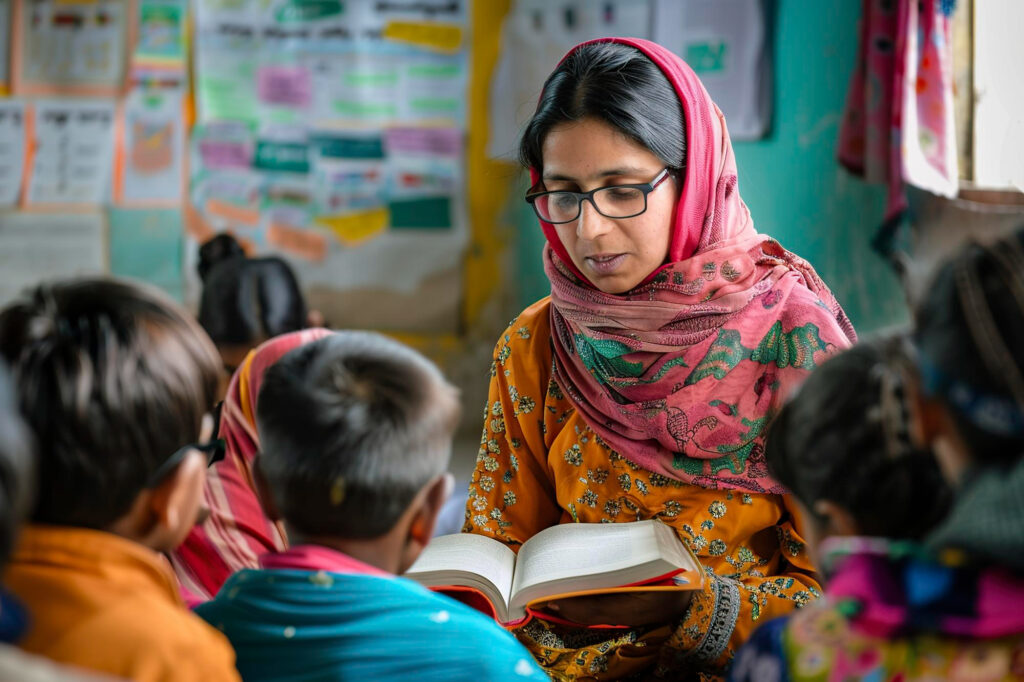
The result is a static licensing regime: a teacher can enter the profession, fail to meaningfully update their practice, and remain “certified” for decades. In an environment where curricula, technology, and student needs shift rapidly, this does not constitute professional certification; it represents institutionalized stagnation.
CPD as Ceremony: Training Without Transformation
Pakistan has experimented with Continuous Professional Development (CPD) frameworks, especially in Punjab and Khyber Pakhtunkhwa. Framework documents talk about school-based learning, teacher group meetings, mentoring, and promotion-linked training. But the reality in many schools remains ceremonial.
Evaluations of the revised CPD framework in Punjab found that teacher group meetings were frequently reduced to compliance exercises: agendas were perfunctory, documentation was poorly maintained, and discussions rarely translated into meaningful changes in classroom practice. A separate study of teacher performance under the CPD framework in Faisalabad similarly concluded that although teachers attended training sessions and expressed generally positive attitudes, shifts in their day-to-day pedagogy were modest and uneven.

For many teachers, CPD still looks depressingly familiar: a circular is issued, teachers are pulled out of schools and sent to a district resource center or hotel hall; they sit through lecture-style presentations and receive standardized handouts. They sign the attendance sheet and return to overcrowded classrooms where no one observes, coaches, or supports them to apply anything new.
However, not all initiatives are superficial. Promotion-linked programs under the Quaid-e-Azam Academy for Educational Development (QAED), for example, have demonstrated improvements in instructional practices when courses are intensive, classroom-focused, and explicitly tied to career progression. These are exceptions that depend on strong local leadership or donor support. Systemically, CPD is still treated as an event rather than an ongoing professional process.
Emerging Bright Spots: When CPD Works Differently
Despite system-level weaknesses, several initiatives in Pakistan demonstrate what serious teacher development can look like. Programs such as Teach For Pakistan, select Aga Khan Education Service schools in Gilgit-Baltistan, and targeted provincial or NGO partnerships point to alternative approaches. These include:
- Regular coaching and observation instead of one-off lectures
- Structured reflection through post-lesson debriefs and peer discussions
- Use of student work and assessment data to inform instruction
- Deliberate integration of low-cost EdTech tools, especially where connectivity is limited
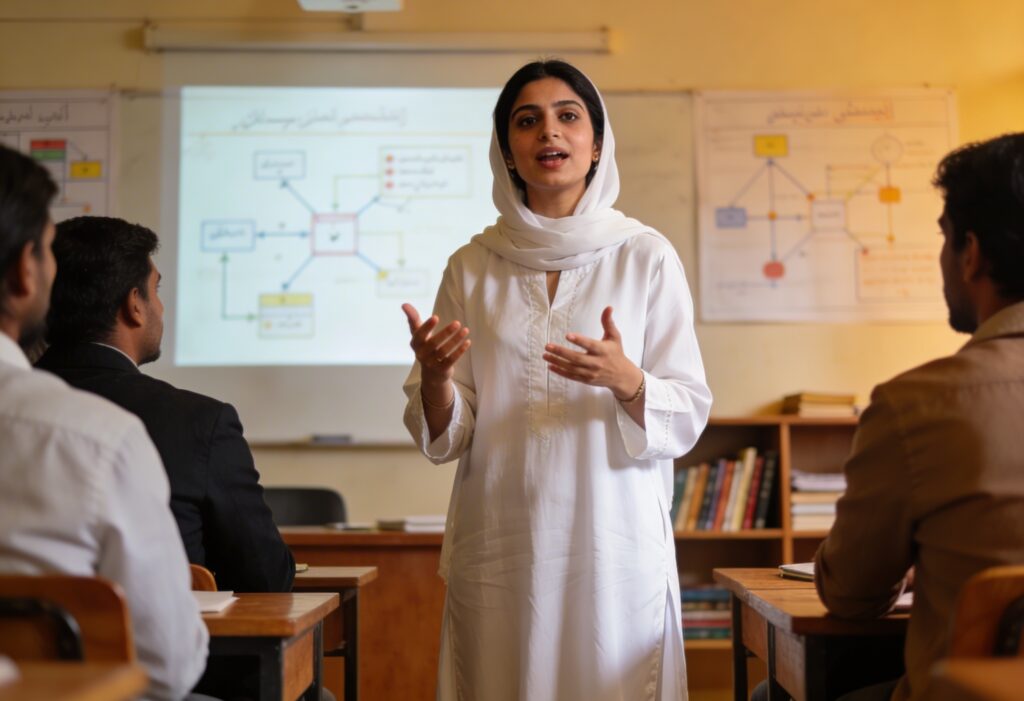
In several Khyber Pakhtunkhwa clusters, school-based CPD and coaching models have been linked to reduced teacher absenteeism and noticeably higher classroom engagement, according to internal monitoring reports. These are not magic bullets, but they show that when teachers receive ongoing, context-specific support, classroom behavior and student participation do shift.
The contrast is uncomfortable but important: where CPD is serious, practice changes; where CPD is ceremonial, teachers and students pay the price.
Digital Readiness and Communities of Practice
The COVID-19 pandemic exposed the unpreparedness of most teachers for remote and blended learning. At the same time, it accelerated Pakistan’s digital transformation. As of early 2024, approximately 111 million people in Pakistan were using the internet. This means nearly half the population, around 46 percent, was online, an increase of more than 24 million new users in just one year. By early 2025, that figure had increased to approximately 116 million, even as significant gaps in connectivity and affordability persist. However, digital competence among teachers is still highly uneven. Research on IT integration in primary schools—including studies from Hyderabad and other urban centers—finds that only a minority of schools have functional computer labs, and that many teachers lack both the infrastructure and training needed to use digital tools meaningfully in their lessons. Where EdTech initiatives do exist, they often emphasize content delivery (apps, TV lessons, portals) over building the confidence and capability of the teachers who must implement and adapt that content.

Ironically, some of the most promising advances in digital teacher learning have occurred outside formal policy frameworks. During school closures, thousands of teachers joined WhatsApp and Facebook groups to share lesson plans, voice notes in Urdu and regional languages, and short recorded explanations. They also coached one another informally on how to use Zoom, WhatsApp video calls, or low-bandwidth platforms with large classes.
These organic networks matter because they operate at minimal cost, transcend geography, system type, and sector, and position teachers as knowledge creators and problem-solvers rather than passive recipients of professional development. Countries such as Malaysia and the UAE are now formally integrating digital communities of practice into teacher standards, appraisal systems, and promotion pathways. Pakistan could pursue a similar approach if policymakers are willing to recognize, legitimize, and support the professional learning already taking place within these informal spaces.
What Modern Certification Should Look Like
If Pakistan seeks a teaching workforce capable of fulfilling its curricular and policy ambitions, it must redesign certification and professional development to prioritize demonstrated competence over formal credentials. This shift would require several concrete reforms:

1.Make Certification Renewable and Performance-Linked
Instead of lifetime licenses, teachers should renew their certification every three to five years. Renewal should require evidence of effective classroom practice, student learning, engagement with meaningful professional development, and adherence to ethical standards and core professional responsibilities. This is not intended to create another bureaucratic hurdle; it is meant to send a clear signal that teaching is a dynamic profession and that staying current is an essential part of the job description
2.Relocate CPD from Hotel Halls to Classrooms
Both international evidence and Pakistan’s own experience suggest that the most effective CPD is job-embedded. Teachers need protected time to plan lessons collaboratively, observe one another, experiment with new strategies, and analyze student work. Research consistently shows that professional development linked to mentoring, classroom observation, and career progression leads to meaningful changes in teaching practice, whereas lecture-based training rarely does. Provincial budgets should therefore prioritize school-based instructional coaches, cluster resource centers, and dedicated time for collaborative planning.
3.Treat Digital Competence as a Core Professional Standard
This does not mean turning every teacher into a programmer. Every certified teacher should be able to use basic EdTech tools to explain concepts, check understanding, manage simple blended learning, evaluate online content, and join at least one digital professional community. International evidence shows that structured ICT training helps teachers continue using technology and improve learning. Pakistan’s B.Ed., M.Ed., and induction programs should be updated to reflect this.
4.Link Professional Development to Results & Well-Being
Evidence from Pakistan and comparable systems suggests that when CPD genuinely improves pedagogy, student engagement and achievement rise. When teachers are exhausted, underpaid, and unsupported, quality declines, regardless of how many workshops they attend. Evaluations of any new certification and CPD reforms must therefore track changes in classroom practice, student learning assessments, and teacher morale, not just the number of participants trained.
From Blame to Responsibility: A Critical but Hopeful Conclusion
It is easy to blame teachers for Pakistan’s learning crisis. It is harder to admit that the education system has never consistently treated teaching as a rigorous profession that demands significant, sustained investment.
The data is blunt: we have a growing pool of “trained” teachers on official records, but stubbornly high learning poverty, millions of out-of-school children, underinvestment in primary education, and a CPD culture that often rewards attendance more than transformation.
Reform requires political courage to depoliticize hiring, redesign certification, and fund school-based support rather than one-time events. Institutions such as QAED, HEC, and provincial departments must embrace mentoring, digital pedagogy, and reflective professional standards as essential requirements.
If Pakistan can build a system where teachers are continuously learning, digitally proficient, and professionally accountable, every other reform, including curriculum, assessment, EdTech, and equity, will finally have a real chance to work. Teaching the teachers, effectively this time, may be the single most transformative education reform Pakistan can undertake.
Disclaimer: Any opinions expressed in this article do not necessarily reflect the opinions of the Pakistan Education Review. This content is meant for informational purposes only.

About the Author:
Saadia Nasim Sheikh is a student and academic writer currently pursuing an M.Phil. in Molecular Medicine. She has a keen interest in education reform, digital learning, and teacher development in Pakistan.