
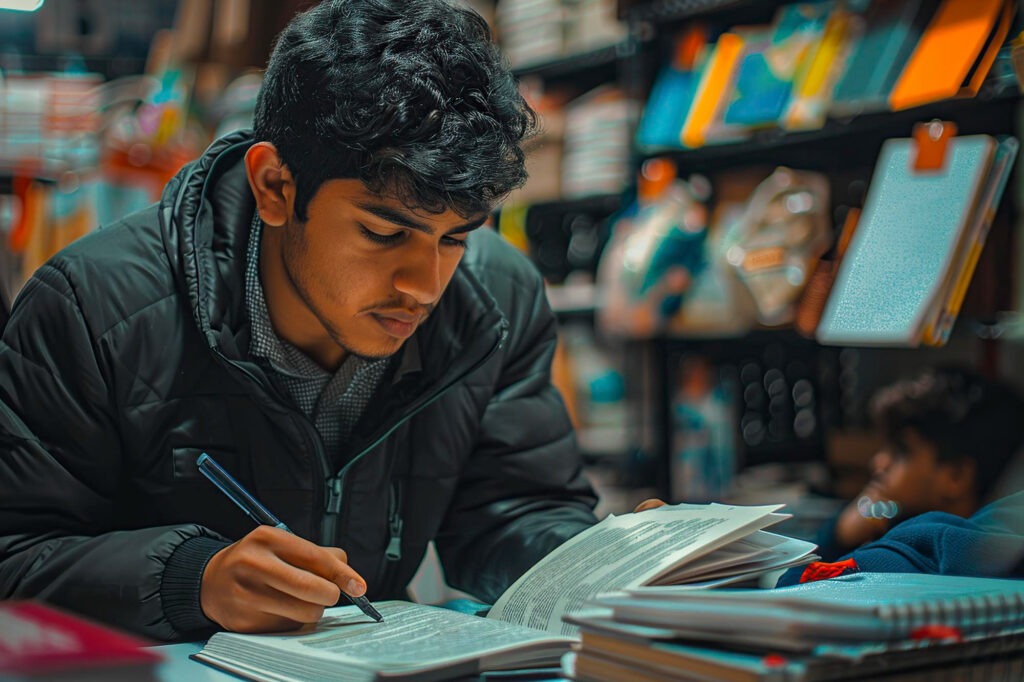
The scene in Pakistan’s examination halls is concerning: students write furiously, bent over their answer sheets, not because they are thinking, but because they are straining to recall what they tried to memorize the night before. Pakistan has continually produced graduates who hold certificates as proof that they sat in classrooms, memorized the prescribed content, and passed the examinations designed to test little beyond recall. The system is not broken in any conventional sense, as it was designed to function precisely this way, which perhaps is the most troubling observation.
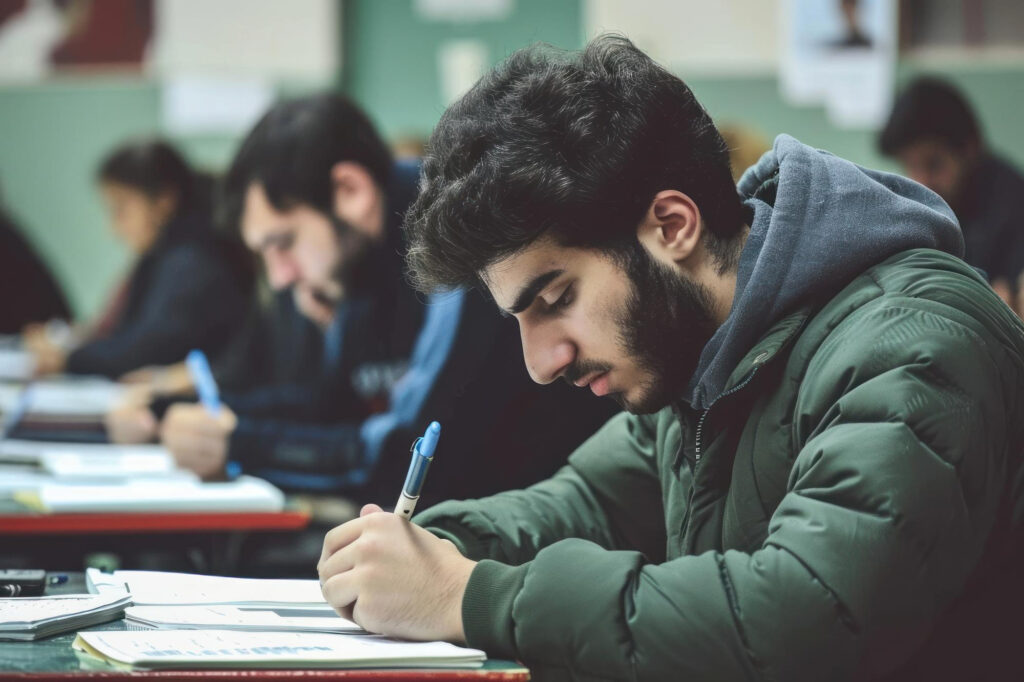
A student who questions the textbook risks falling behind; one who memorizes the content without any thought earns marks, admissions, and ultimately employment. Pakistan’s incentive structure is designed to punish curiosity instead of rewarding it. This is visible from board exam culture to MDCAT and CSS preparation, where students cram marking schemes and predicted questions but rarely pause to understand the underlying concepts they are studying. Enter any classroom in Pakistan, and what one typically observes is dictation: transmission and reception. The “why” behind rules/concepts rarely surfaces. During the examinations, the winner is not the one who understood the concept; rather, it is the one who can reproduce a definition word for word.
The textbooks themselves compound the problem. They sanitize everything, filter content through ideology, and present information as unassailable. History carries no nuance, science invites no questioning, literature holds no mystery. By the end of twelve years, a student may be knowledgeable in some narrow sense but is rarely reflective in any meaningful one. According to the National Education Policy Development Framework 2024, only around five percent of children in Pakistan receive good-quality education; this figure speaks not merely to access but to the kind of learning taking place in the country.
The consequences of this system are unfolding across national life. Pakistan’s technology sector has grown, but it remains oriented toward execution rather than invention. The country produces coders who can implement; it struggles to produce architects who can conceive. Leadership suffers similarly; true leadership demands the ability to analyze conflicting situations, tolerate ambiguity, and act without assurance. Our system rewards producing the correct answer quickly, not sitting with a problem long enough to form an original view. That deficiency is apparent when a graduate occupies a decision-making position.
Civic competence is also negatively affected. Educated citizens should be able to identify how power operates, challenge those who abuse it, and participate meaningfully in public life. Our system produces graduates who can recite constitutional provisions but cannot evaluate whether an institution is upholding them. On social media, this shows up as educated people whose grasp of politics rests on emotional clips and partisan rhetoric.
This vulnerability has national security implications. During the May 2025 India-Pakistan conflict, a parallel digital war unfolded alongside the military one: AI-generated deepfakes, recycled footage from unrelated conflicts, and fabricated audio of senior leaders spread faster than any verification could keep up with. Even journalists and government officials were misled. A populace skilled in consuming information rather than interrogating it cannot defend itself in this environment. A student trained only to memorize cannot distinguish a well-constructed argument from a well-articulated one. He cannot identify the assumption embedded in a claim or the evidence that has been omitted. In an age of modern warfare, this is as much a national security problem as an educational one.
Pakistan does not need a more efficient version of what it already has. It needs a generation of thinkers, such people who question what is taken for granted, frame and test hypotheses, distinguish knowledge from belief, and argue with intellectual integrity. These capacities are not innate; they develop over years of deliberate practice.

Reform must be multi-faceted. With public education spending at just 0.8 percent of GDP in 2024–25, and over fifty percent of teachers reportedly lacking formal pedagogical training, the gap between aspiration and reality is not rhetorical. University assessments must move away from rote recall toward formats that test analytical depth and the capacity to argue. At the school level, teacher development is the central lever: a skilled teacher with a weak curriculum will outperform a weak teacher with an excellent one. Teaching educators to facilitate discussion, reward process over correct output, and make intellectual risk feel safe: this is the actual work of transformation. Research culture must be rehabilitated too, connecting universities to real national problems rather than treating scholarship as a bureaucratic requirement for promotion.
Most importantly, the conversation must be reframed around national purpose. What is a Pakistani student being educated for? If the answer is a government job or emigration, the system will optimize accordingly. If the answer is to understand and improve this country, the entire orientation will shift. Pakistan possesses extraordinary human potential in the form of young, numerous, and intensely motivated human capital. The question is not whether that potential exists; it is rather about what kind of education system it will pass through. A system that demands memorization will produce memorizers. A system that demands thought will, gradually, produce thinkers. And thinkers, in the end, are what any serious nation is built on.
Disclaimer: Any opinions expressed in this article do not necessarily reflect the opinions of the Pakistan Education Review. This content is meant for informational purposes only.
About the Author:
Muhammad Baloch is a law student at the University of London with a research-oriented academic background. His interests include Pakistan’s legal, political, and historical systems, with a particular focus on their underlying structures and development.