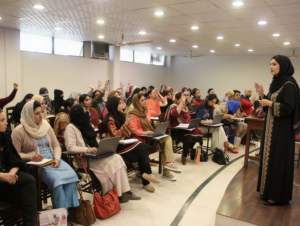


In recent years, Pakistan has seen a quiet but consequential shift in its higher education landscape. International universities, from the University of Bedfordshire and East Anglia to Arizona State University (through its partnership with the National Institute of Technology in Lahore), are expanding their footprint in Pakistan. The Punjab government under Maryam Nawaz has encouraged global universities to establish campuses locally, framing this as a step toward academic excellence and international collaboration.
Yet this policy enthusiasm also reveals an uncomfortable truth. The state’s active encouragement of transnational education providers is, in part, an acknowledgment of the declining capacity of Pakistan’s public higher education system to meet growing demand. Chronic underfunding, outdated curricula, and uneven governance have created a vacuum that foreign institutions now fill. Instead of reforming public universities to deliver globally competitive education, the state has increasingly looked outward for solutions. In this sense, the rise of transnational education reflects not only aspiration but also institutional retreat: a quiet admission that the domestic system, in its current form, cannot deliver at scale.
At one level, transnational education represents an opportunity. It allows Pakistani students to access international curricula, pedagogical methods, and networks without bearing the full financial burden of studying abroad. The University of London’s recognized teaching centres, for instance, provide globally accredited degrees across law, business, and social sciences at a fraction of overseas costs. Similarly, the ASU–NIT partnership promises to bring cutting-edge teaching in digital technologies and business innovation directly to Pakistan’s students. Such initiatives help retain talent and reduce capital outflow while raising the academic benchmark for local institutions.

But this optimism must be balanced with realism. Most transnational programs cater to a small, urban, and relatively affluent segment of society. Their tuition fees remain far beyond the reach of the average Pakistani student. This raises a broader policy dilemma: how can a model rooted in exclusivity contribute to a public education system struggling with underfunding, overcrowding, and uneven quality?
Pakistan’s higher education sector remains constrained by fiscal limits. The Economic Survey 2024–25 shows that cumulative education spending has fallen to 0.8 percent of GDP, among the lowest in the region. The Higher Education Commission’s development budget for 2025–26 allocates Rs 39.48 billion; however, over 97 percent of that is earmarked for ongoing projects, leaving little for new initiatives. Within this environment, international collaborations appear attractive precisely because they bring private capital, global branding, and relative stability. However, their benefits will remain narrow unless policy deliberately links these ventures to public outcomes.

There are several ways to achieve this. First, transnational institutions could be integrated into the national skills and innovation ecosystem. Collaborative research grants, internships, and technology transfer programs can connect foreign-affiliated campuses to local industry and public universities. Second, regulatory incentives could encourage these institutions to reserve a portion of their seats or scholarships for students from lower-income backgrounds. Such inclusionary frameworks exist in several middle-income countries that have embraced foreign university partnerships while safeguarding access.
Third, the government and the Higher Education Commission (HEC) can negotiate reciprocal arrangements where foreign partners contribute to national academic capacity through faculty training, curriculum development, or joint research centres. This shifts transnational education from a commercial enterprise to a component of national capacity-building. For example, the ASU–NIT partnership could serve as a pilot for faculty development initiatives benefiting not only its own students but also educators from public universities across Punjab.

There is also a cultural dimension to consider. The appeal of international degrees often stems from a perception that they guarantee employability and prestige. Addressing this perception requires domestic universities to demonstrate comparable quality and outcomes. Strengthening accreditation systems, improving research funding, and fostering ties between academia and industry are essential to restoring public confidence in local institutions. Only then can transnational education operate as a complement rather than a substitute for domestic reform.
From an economic standpoint, transnational education can play a catalytic role if strategically managed. It can help retain foreign exchange, attract foreign investment in educational infrastructure, and foster global linkages for innovation and entrepreneurship. Yet these gains are meaningful only if they reinforce—not replace—Pakistan’s public higher education mission. The goal should not be to privatize access to quality learning but to use international collaboration as leverage for systemic improvement.
Ultimately, the emergence of transnational universities in Pakistan reflects both ambition and anxiety: ambition to connect with global academia, and anxiety over the capacity of local systems to deliver comparable quality. The task of public policy is to reconcile these forces. If international collaborations remain confined to gated educational enclaves, their long-term impact will be limited. But if they are woven into the broader national strategy for skills, research, and inclusion, they could become vital instruments of reform.
Pakistan’s higher education sector requires global engagement—but on terms that are equitable and aligned with national priorities. The measure of success will not be how many foreign universities set up campuses, but whether their presence strengthens the public institutions that serve the majority. For transnational education to truly contribute to development, it must help bridge divides, not reinforce them.
Disclaimer: Any opinions expressed in this article do not necessarily reflect the opinions of the Pakistan Education Review. This content is meant for informational purposes only.

About the Author:
Suleman Zia is a Lahore-based transnational education consultant, freelance columnist, and policy analyst. His work has appeared in Dawn Prism, The Friday Times, Pakistan Today, The News International, and Daily Times.